
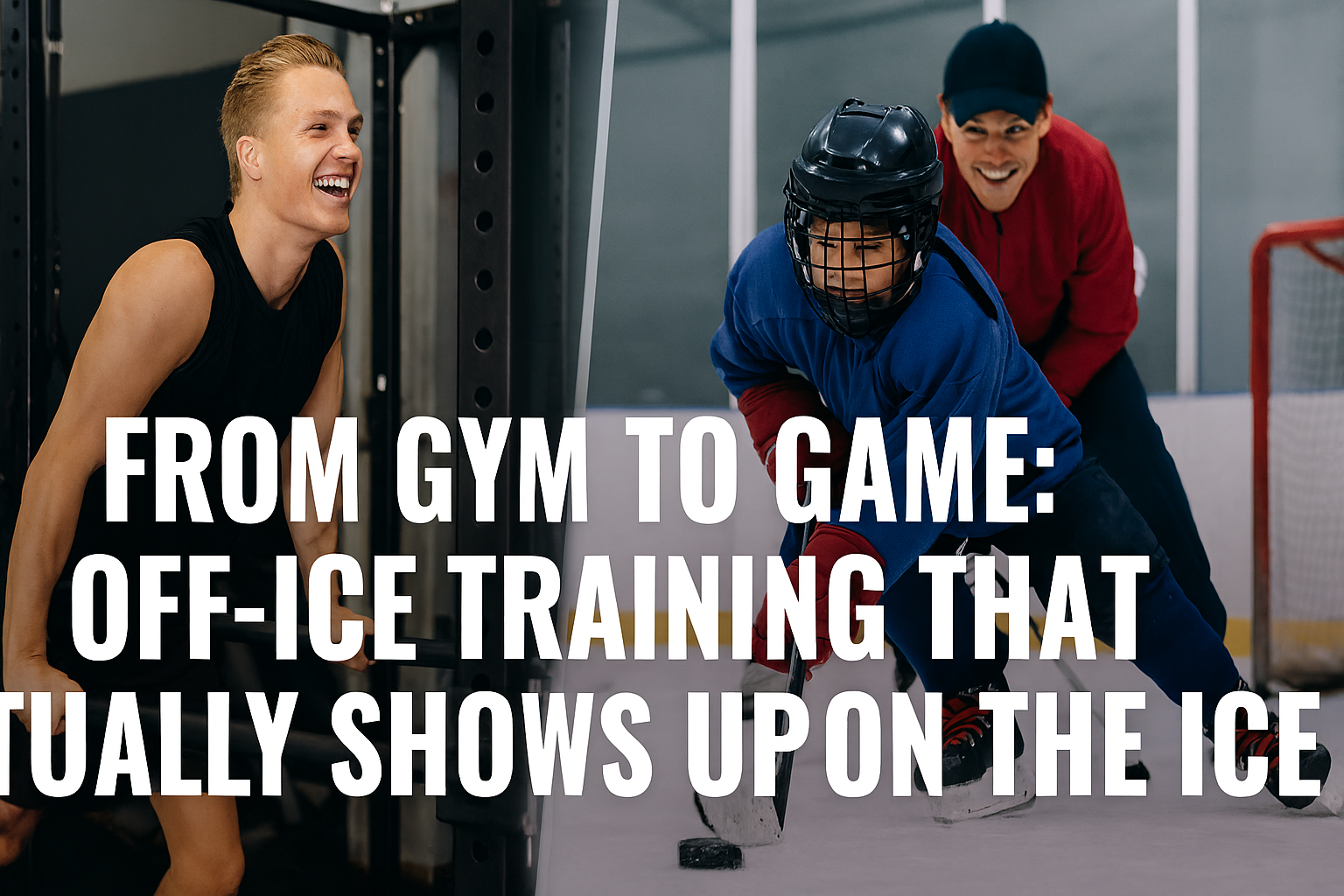
From gym to game: Off-ice training that actually shows up on the ice
Author: 1Rink Editor
Players and parents hear it constantly: “Get stronger, get faster.” But not all training translates. Some workouts build a great sweat and zero game impact. Others target the exact qualities that make hockey players explosive, resilient, and effective shift after shift. This guide breaks down off-ice training that reliably carries over to the rink—what to prioritize, what to skip, and how to build a week that supports real performance without burning kids out.
Why transfer matters more than tiredness
Hockey demands short, violent bursts powered by strong legs, a stable core, and quick decision-making under fatigue. Off-ice work should reflect that: think acceleration, change of direction, unilateral strength, rotational power, and energy system repeatability. If a workout leaves a player exhausted but doesn’t improve these specific buckets, it’s noise. Systems like Hockey Canada’s Long-Term Player Development (LTAD) and USA Hockey’s American Development Model (ADM) emphasize age-appropriate training that develops foundational movement first, then strength and power—because the goal is long-term transfer, not short-term soreness.
- Why it matters: A training plan matched to a player’s stage of development prevents plateaus and reduces injury risk while steadily improving on-ice performance.
Explore LTAD and ADM to align training with growth and development milestones:
The five pillars that show up on the ice
1) Acceleration and change of direction
Hockey is won on the first three steps. Off-ice, short sprints (10–20 meters), hill sprints, resisted starts, and lateral shuffles build the alactic speed that defines breakaway separation and gap control. There’s strong evidence that improvements in off-ice sprint and power metrics correlate with faster skating in youth and junior players—especially when paired with progressive strength training.
- Do: 4–6 sets of 10–20 m sprints with full recovery; lateral bounds; low-volume agility with planned cuts.
- Avoid: Endless “cone chaos.” Speed quality>volume; stop when speed drops.
See research linking off-ice power to on-ice speed:Farlinger et al., JSCR
2) Single-leg strength and stability
Skating is a single-leg sport. Split squats, rear-foot elevated split squats (RFESS), step-downs, and single-leg RDLs build force in the positions players actually use. These lifts feed both top speed and balance through contact.
- Do: 2–4 sets of 6–10 reps on unilateral lower-body lifts; progress weekly by small loads or reps.
- Avoid: Max back squats for youth; strength first, maximal loading much later.
The National Strength and Conditioning Association (NSCA) supports supervised, progressive youth resistance training for performance and injury reduction:NSCA Position Statement
3) Rotational power and anti-rotation control
Shots, passes, puck protection—these are rotational. Med-ball throws (scoop and shot-put), rotational lifts, and anti-rotation holds (Pallof press) turn strength into usable power and keep the torso stable under checks.
- Do: 3–5 reps per side of high-intent med-ball throws, 3–5 sets; finish fresh.
- Avoid: Endless crunches; prioritize power and spine-friendly core work.
4) Hip mobility and tissue capacity
Players live in hip flexion and external rotation. Protect hips with dynamic warm-ups (leg swings, spidermans with rotation), targeted mobility (90/90, adductor rock-backs), and posterior-chain strength. This reduces groin issues and supports deeper, more powerful strides.
- Do: 8–10 minutes of mobility before sessions and a short reset after.
- Avoid: Static-only routines; combine mobility with strength and control.
5) Energy systems that fit hockey
Hockey is repeated anaerobic efforts with partial recovery. Condition with short, intense intervals (10–30 seconds) and full-to-partial rest, plus tempo work for aerobic base. Save long, steady cardio for recovery days or when rebuilding base capacity.
- Do: 6–10 x 15-second high-output efforts with 45–60 seconds rest; tempo bike or jog 20–30 minutes easy.
- Avoid: Daily high-intensity conditioning; under-recovered players lose speed and skill.
A practical weekly template
Adjust volume by age, season phase, and game density. Quality beats quantity. If in-season, cut total sets by ~30–40% and keep power work snappy.
- Day 1: Speed + Lower-body strength (sprints 10–20 m; RFESS; single-leg RDL; med-ball throws)
- Day 2: Mobility + Upper-body strength (push/pull supersets; anti-rotation core; light aerobic flush)
- Day 3: Conditioning (anaerobic intervals matched to shift length; finish with hip mobility)
- Day 4: Speed + Power (lateral bounds; acceleration starts; rotational med-ball; brief full-body lift)
- Day 5: Recovery (walk, mobility circuit, light bike; 20–30 minutes)
Younger players (under ~14) should lean toward movement skills, light resistance, and games that build coordination. ADM and LTAD are clear: build the athlete before the specialist.
What to stop doing
- Endless bag skates and HIIT every day: They crush nervous system freshness. Speed dies without recovery.
- Random “epic” circuits: If it doesn’t map to hockey qualities, it’s entertainment, not development.
- Max lifts without coaching: Technique, tempo, and progression matter more than load in youth athletes.
- Over-scheduling: More isn’t better—better is better. Leave time for sleep and school.
Measuring what matters (without lab gear)
- 10 m and 20 m sprint times: Use a phone timer consistently on the same surface.
- Countermovement jump height: Measure with an app or chalk mark; track weekly averages.
- Med-ball throw distance: Same ball, same setup, 3–5 attempts; log best.
- Repeat sprint quality: Time the first and last rep; small drop-off = better game fitness.
At older ages, NHL Combine-style testing offers context (e.g., vertical jump, pull-ups, Wingate). But the message to families is simple: pick a few reliable tests and track them quarterly. Trend lines beat single-day heroics.
Learn about Combine testing formats here:NHL Scouting Combine overview
Recovery: the hidden edge
Sleep is the cheapest performance enhancer. Teens generally need 8–10 hours; chronic short sleep dings reaction time, mood, and learning—the exact elements that underwrite hockey IQ and skill acquisition. Nutrition matters too: protein at each meal, carbs around practices/games, and consistent hydration. Build easy wins: consistent bedtime, devices out of the room, and a simple post-skate refuel.
- Sleep target: 8–10 hours for teens; dark, cool, quiet room; similar sleep/wake times.
- Refuel: 20–30g protein plus carbs within 60 minutes post-ice.
Sleep guidelines for youth:CDC: How much sleep do I need?
Safety, readiness, and specialization
Well-designed strength programs are safe and beneficial for kids when supervised and progressively loaded. What’s not helpful is rushing into adult-style programs or specializing too early. Multi-sport and free play build coordination and reduce overuse injury risk, and they keep motivation high. The goal is to arrive at the late-teen years healthy, athletic, and hungry—not burnt out.
- Green flags: Coach supervision; gradual progressions; technique-first culture.
- Red flags: Pain brushed off; “no days off” messaging; max-out culture for youth.
Read more on safe youth strength training and specialization:
- NSCA: Youth Resistance Training Position Statement
- American Academy of Pediatrics: Youth Sports Specialization
Putting it all together
If you remember one thing, make it this: train what the game demands. For hockey, that means acceleration, unilateral strength, rotational power, agile hips, and repeatable high-intensity efforts—supported by sleep and smart scheduling. Keep sessions crisp, measurable, and matched to a player’s age and season. Parents: your biggest wins are helping set routines, protecting rest, and choosing environments that prioritize teaching over theatrics. Players: own your habits, track your progress, and chase quality. When the right work meets the right recovery, the difference shows up where it counts—the next time the puck drops.
Sources:
Hockey Canada LTAD
USA Hockey American Development Model
NSCA Position Statement on Youth Resistance Training
Farlinger et al., Journal of Strength and Conditioning Research
CDC Sleep Recommendations
NHL Scouting Combine: Fitness Testing Overview
American Academy of Pediatrics: Youth Sports Specialization