
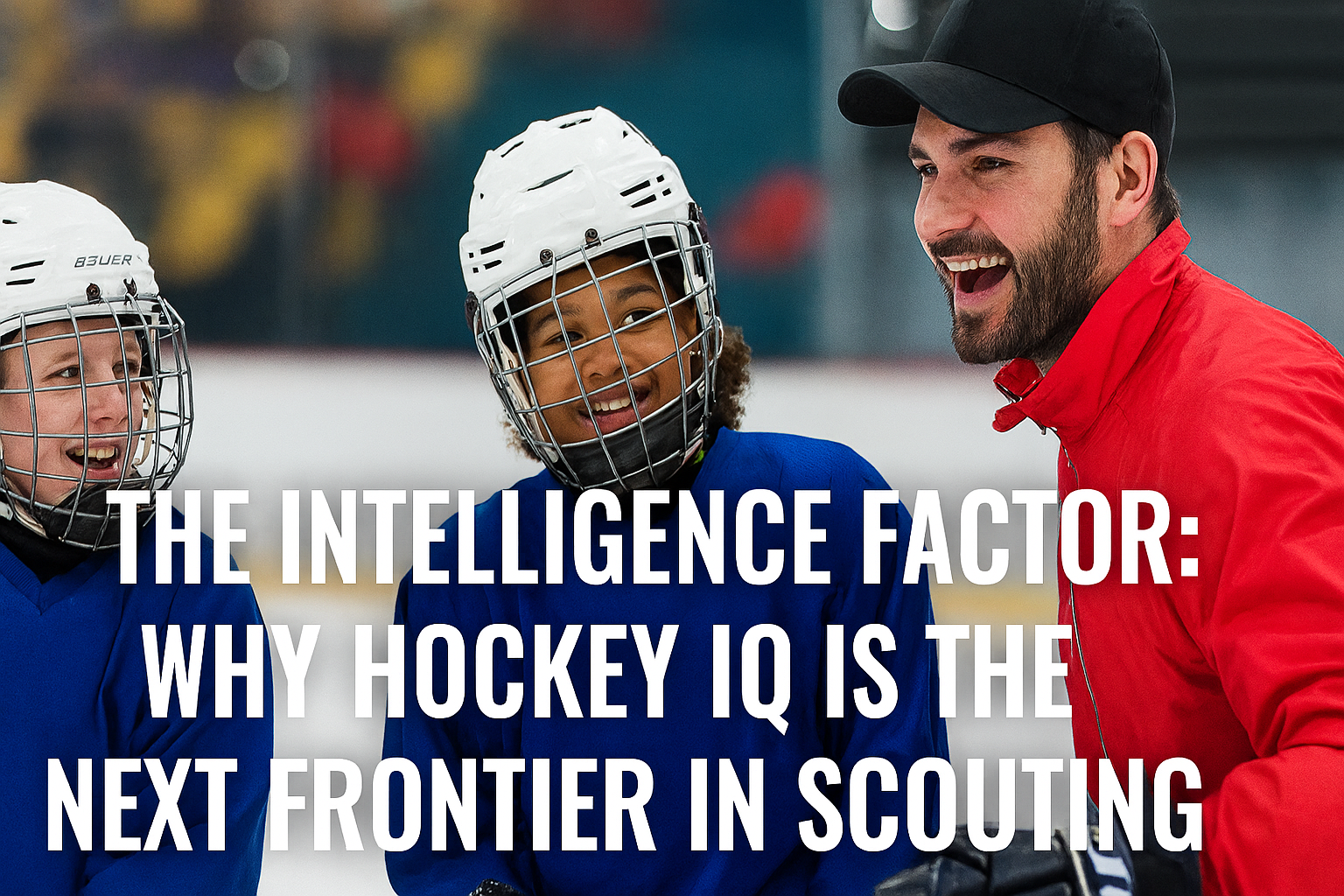
The Intelligence Factor: Why Hockey IQ Is the Next Frontier in Scouting
Author: 1Rink Editor
In the ever-evolving world of hockey scouting, physical attributes like speed, size, and strength have long dominated the conversation. But as the game becomes faster and more system-driven, a new metric is rising to prominence—hockey IQ. For players and parents navigating the development journey, understanding and cultivating this intangible skill could be the difference between plateauing and breaking through.
What Is Hockey IQ?
Hockey IQ refers to a player’s ability to read the game, anticipate plays, make smart decisions under pressure, and adapt to changing situations. It’s not about academic intelligence—it’s about processing information quickly and applying it in real time on the ice. Scouts are increasingly recognizing that a player with elite hockey sense can outperform more physically gifted peers simply by being in the right place at the right time.
Dr. Leonard Zaichkowsky, a former performance psychologist for the Boston Bruins, emphasized in his book The Playmaker’s Advantage that “cognitive skills like anticipation, pattern recognition, and decision-making are what separate good athletes from great ones.” In hockey, these skills manifest as hockey IQ.
Why Scouts Are Shifting Focus
As analytics and video breakdowns become more sophisticated, scouts are better equipped to evaluate decision-making and situational awareness. The rise of systems-heavy play in junior and professional leagues has made it clear: players who can think the game are more adaptable, coachable, and valuable.
Consider the success of players like Patrice Bergeron or Sidney Crosby—not the fastest or biggest, but consistently dominant due to their elite understanding of the game. Their ability to anticipate puck movement, exploit defensive gaps, and make high-percentage plays is a masterclass in hockey IQ.
How Players Can Develop Hockey IQ
Unlike physical traits, hockey IQ can be nurtured. Here are some proven strategies:
- Watch Games Actively: Don’t just watch for entertainment—study positioning, decision-making, and transitions. Ask questions like “Why did that pass work?” or “What could that defender have done differently?”
- Video Review: Reviewing your own games helps identify patterns in your play. Are you consistently late to puck battles? Do you miss open teammates? Self-awareness is the first step to improvement.
- Small-Area Games: These drills force quick decisions in tight spaces, mimicking game-like pressure and enhancing spatial awareness.
- Play Multiple Positions: Understanding different roles deepens your grasp of team systems and improves your anticipation.
According to a study published in the Journal of Sports Sciences , athletes who engage in deliberate cognitive training—such as video analysis and tactical discussions—show measurable improvements in decision-making speed and accuracy.
What Parents Should Know
Parents often focus on physical development: skating lessons, strength training, nutrition. While these are essential, fostering hockey IQ requires a different approach. Encourage your child to:
- Ask questions during practices and games
- Reflect on their performance beyond goals and assists
- Engage with coaches about tactical concepts
It’s also important to understand that hockey IQ isn’t always visible in box scores. A player who makes the right play to sustain offensive zone pressure or who reads a breakout perfectly may not get a point—but they’re making winning plays. Scouts notice.
Scouting Hockey IQ: What They’re Looking For
When scouts evaluate hockey IQ, they’re watching for:
- Anticipation: Does the player read the play before it happens?
- Decision-Making: Are they making smart choices with and without the puck?
- Adaptability: Can they adjust to different systems or roles?
- Off-Puck Awareness: Do they position themselves effectively when not directly involved in the play?
These traits are especially valuable in high-pressure environments like national tournaments or showcase events, where split-second decisions can define a player’s impact.
Hockey IQ and the NCAA Pathway
With the recent eligibility changes allowing CHL players to pursue NCAA opportunities starting in 2025, the emphasis on hockey IQ becomes even more critical. NCAA programs often prioritize system-oriented players who can execute complex strategies and adapt to structured play. A high hockey IQ can make a player more attractive to college recruiters, regardless of their junior league background.
As noted by College Hockey Inc., “Coaches at the NCAA level are looking for players who can think the game at a high level. The ability to process and execute within a system is often what separates recruits.”
Conclusion: The Smart Player Advantage
In today’s game, being smart is just as important as being strong. Hockey IQ is the silent engine behind elite performance, and it’s increasingly becoming a focal point for scouts, coaches, and recruiters. For players and parents, investing in the mental side of the game isn’t optional—it’s essential.
Whether you’re a bantam player dreaming of college hockey or a midget parent navigating the scouting maze, remember: the smartest players often have the longest careers. And that’s something worth thinking about.
Sources:
- Zaichkowsky, L., & Peterson, D. (2018).The Playmaker’s Advantage . Jeter Publishing.
- Journal of Sports Sciences, Volume 38, Issue 5 (2020). “Cognitive Training and Decision-Making in Youth Athletes.”
- College Hockey Inc. (2025). “NCAA Eligibility and Scouting Trends.”